
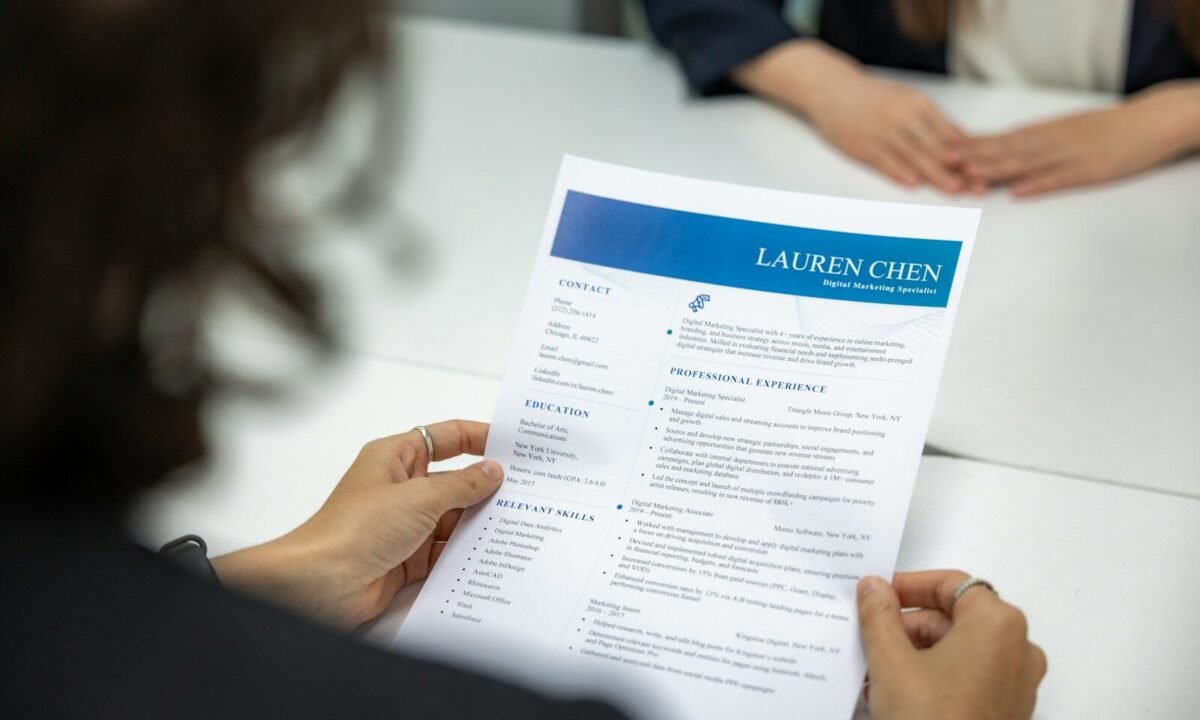

A CV is not a complete history of everything you have ever done. It is a selection of evidence that helps an employer answer one question: does this person look capable of doing this job?
That means the final review should not focus only on spelling. Before each application, check whether the document is relevant, easy to scan and supported by evidence.
ARTICLE CONTENTSOn this page 9 sections
1. Match the top third of the CV to the role
The first section should quickly establish who you are professionally and why the role makes sense. If you use a profile or summary, remove broad claims that could belong to anyone. Mention your field, strongest relevant experience and the kind of value you have delivered.
For an early-career applicant, education, projects, internships and practical skills may deserve more space near the top than a long personal statement.
2. Use the vacancy to decide what deserves space
Read the responsibilities and requirements again. Highlight the skills or experience that appear repeatedly, then make sure your CV gives evidence of the ones you genuinely have. This is not about copying the advert word for word. It is about making relevant experience visible.
If a job is heavily focused on customer support and your strongest example is buried under unrelated duties, move the useful evidence forward.
3. Turn duties into evidence
“Responsible for social media” tells the employer what your job description said. “Planned and published a weekly content calendar across three channels” tells the employer what you actually did.
Where possible, include the scale, result or context of your work. Not every bullet needs a percentage. Clear evidence is more important than impressive-looking numbers with no meaning.
4. Remove information that competes with your strongest case
Older or unrelated experience can stay if it demonstrates transferable value, but it should not dominate. A one-page CV is not a universal rule, and neither is a two-page CV. Use the amount of space needed to present relevant evidence without making the reviewer search for it.
5. Keep formatting predictable
Use clear section headings, consistent dates and enough white space. Avoid putting essential information inside decorative graphics that may be difficult to read on smaller screens or by recruitment software. A visually clean CV does not need to be visually complicated.
Use a readable file name too. Something like FirstName-LastName-CV.pdf is more useful than my-new-cv-final2.pdf.
6. Check contact details like they are part of the application
Confirm that your phone number works, your email address is professional enough for job applications and any portfolio or LinkedIn link opens correctly. A small typo in contact information can make a strong CV useless.
7. Review dates and claims for consistency
Employers may compare your CV with an application form or professional profile. Make sure job titles, dates, qualifications and employers are accurate. If there is a career gap, you do not need to invent activity to fill it. Be prepared to explain the timeline honestly if asked.
8. Save a clean master and create targeted versions
Keep one complete master CV containing your useful experience, achievements and project details. For each serious application, make a copy and adjust the order and emphasis to the role. This is faster than rebuilding from scratch and more effective than sending one generic CV everywhere.
Final 60-second check
- Is the job title or career direction clear near the top?
- Does the CV show evidence for the most important requirements?
- Are the strongest bullets about achievements and actions rather than vague traits?
- Are dates, names and qualifications consistent?
- Do all links and contact details work?
- Is the PDF readable on a phone as well as a laptop?
- Is the file name professional?
- Have you removed spelling errors and accidental tracked changes?
The best final question is simple: if the employer spends only 20 to 30 seconds on the first scan, will the evidence you most want them to notice be easy to find? If the answer is no, improve the order before you improve the decoration.





0 comments
Open the discussion when you need it. Comments stay collapsed until requested so the initial article remains light.